
What Is Neurodivergence?
Different brains work in different ways.
Neurodivergence is an umbrella term used to describe differences in how people’s brains process information, learn, communicate, focus, experience the world, and manage everyday life.
If some of the language around neurodivergence is new to you, you’re in the right place! We’ve put together a plain-English introduction to some of the terms you’ll see throughout NeuroLocker, and why they matter in real life.
Neurodivergence in plain English
Neurodiversity is the idea that people experience and interact with the world around them in many different ways – there is no one “right” way of thinking, learning, and behaving. (Harvard Health)
Neurodivergent is the nonmedical term given for a person whose brain processes, learns, or behaves differently than society’s typical norm. (Cleveland Clinic)
Neurotypical is the term given to someone who has a brain that develops and functions in a manner considered “typical” or standard within society. This group of people makes up approx. 80-85% of the global population. (Advanced Autism Services)
*Neurodivergence isn’t one diagnosis or one experience. Two people with the same diagnosis can have very different strengths, challenges, and support needs.
What can neurodivergence include?
This isn’t intended to be a complete list or a diagnostic guide. Neurodivergence is broad, and every person’s experience is different.
ADHD
Can affect attention regulation, working memory, time awareness, task initiation, impulse control, and more.
Autism
Can influence communication, sensory processing, routines, social interaction, transitions, and how someone experiences their environment.
Dyslexia
A learning difference that affects one’s reading and languge processing. This has nothing to do with intelligence.
OCD
Involves recurring intrusive thoughts and/or compulsions and is much more complex than simply liking things organized.
What is executive function?
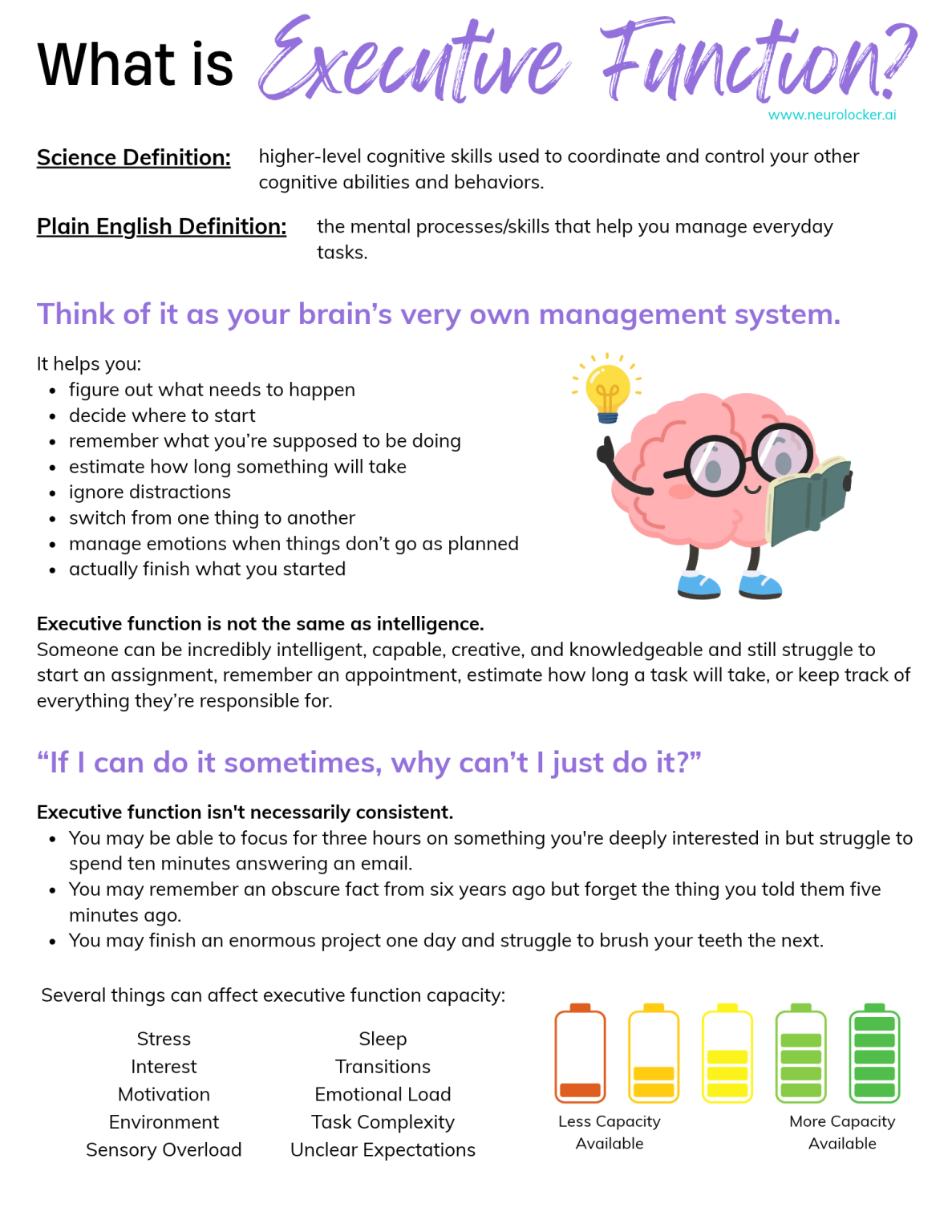
Executive function is the mental processes/skills that help you manage everyday tasks like making plans, solving problems, and adapting to new situations. (Cleveland Clinic)
It’s like an air traffic control system in the brain, helping us manage information, make decisions, and plan ahead. (Harvard University)
Executive function helps us:
Remember
Hold information in mind long enough to use it.
Start
Move from knowing something needs to happen to actually beginning it.
Plan
Figure out the steps between where we are and where we need to be.
Prioritize
Decide what needs attention first.
Manage Time
Understand how long things take and when we need to begin.
Focus
Direct and redirect attention.
Shift
Move between tasks, expectations, or plans.
Follow Through
Keep moving through the steps until something is complete.
Executive function isn’t intelligence.
Someone can be incredibly intelligent, capable, creative, and knowledgeable and still struggle to start an assignment, remember an appointment, estimate how long a task will take, or keep track of everything they’re responsible for.
Understanding Executive Function Guide
A practical, easy-to-understand guide to executive function – what it is, how it shows up in everyday life, and strategies that can help when your brain gets stuck.
Other terms you might see here
Understanding Executive Function
Cognitive Load: the total amount of mental effort your working memory uses at one time.
Decision Fatigue: when your body gets tired of making decisions. The more decisions you make, the more drained you become.
Time Blindness: having difficulty accurately perceiving and managing your time.
Task Initiation: one’s ability to begin a task without excessive procrastination or avoidance.
Working Memory: one’s ability to work with information without losing track of what you’re doing, kind of like a temporary sticky note in the brain.
Experiencing the World
Masking: when you repress or hide signs of mental health conditions to blend in or adapt to the neurotypical world. Can occur consciously or unconsciously.
Sensory Processing: the way the brain receives, organize, and responds to sensory input in order to behave in a meaningful and consistent manner.
Burnout: a form of exhaustion caused when you experience too much emotional, physical, and mental fatigue for too long.
Getting the Right Support
Self-Advocacy: the ability to understand your needs, know what support might help, and communicate those needs to others.
Accommodations: a change that removes a barrier to learning or getting the work done. Expectations are the same, with or without accommodations.
IEP: a legal document that allows a student with a disability specialized instruction, services, and supports to help them learn in the general classroom. This document gives legal rights to parents and students.
504 Plan: a document that provides supports so a student with a disability can learn alongside their peers in general education.
Types of Neurodiversity
*This is a non-exhaustive list that includes the types of neurodivergence we are focused on at NeuroLocker. To learn about other types of neurodivergence, click here.
ADHD: a neurodevelopmental disorder characterized by inattention, hyperactivity, and impulsivity. ADHD is known to impact the individual aspects of someone’s life including academic and professional achievements, interpersonal relationships, and daily functioning.
Autism (ASD): a developmental disability that affects how someone thinks, communicates, and interacts with the world around them. People with Autism think, process senses, move, communicate, and socialize differently.
Dyslexia: a language-based learning disability that affects one’s ability to read, write, spell, and pronounce words. One in 10 people have dyslexia worldwide.
Dyscalculia: a learning disorder that affects a person’s ability to do math and read numbers.
Dysgraphia: a neurological condition that causes someone to have difficulty writing. This can range from issues with the physical act of writing to issues translating thoughts into words.
Apraxia: a brain disorder that causes a person to be unable to perform tasks or movements when asked, even though the request is understood and they are willing to perform the task. The most common is Speech Apraxia – trouble planning the mouth and tongue movements needed to speak clearly.
Obsessive-Compulsive Disorder (OCD): a serious and often debilitating mental health/anxiety disorder that occurs when a person gets caught in a cycle of obsessions and compulsions.
Obsessions: unwanted, intrusive thoughts, images, or urges that trigger intensely distressing feelings.
Compulsions: behaviors an individual engages in to attempt to get rid of the obsessions and/or decrease distress.
Other Terms
Lived Experience: knowledge and understanding gained through personally experiencing something rather than only learning about it from the outside. At NeuroLocker, lived experience helps shape how we think about the challenges people face and the tools that can make everyday life easier.
Neurospicy: internet-born slang term used as a casual synonym for neurodivergent.
Productivity: the ability of an individual, team, or organization to work efficiently within a certain time frame in order to maximize output.
Why this matters to NeuroLocker
NeuroLocker wasn’t built around the idea that people need to try harder. It was built around the reality that remembering, organizing, prioritizing, focusing, and following through can require different kinds of support.
That’s why NeuroLocker brings tools for capturing information, organizing what matters, focusing on what’s next, and following through into one place. The goal isn’t to change how someone’s brain works. It’s to make everyday life easier to navigate.
 English